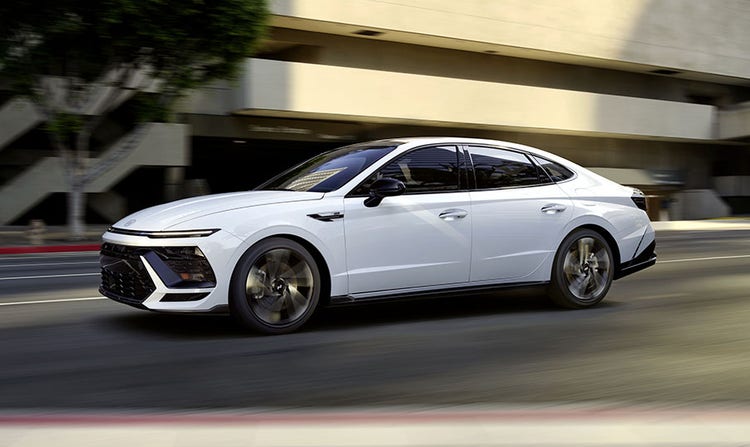
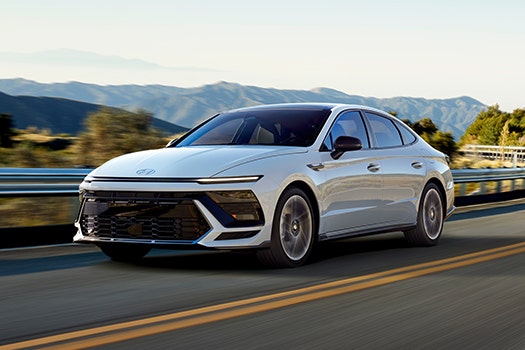
The Hyundai ELANTRA and SONATA are both award-winning sedans with comfortable interiors, impressive technology, and helpful safety features. However, each vehicle also comes with its own unique advantages.
If you are interested in the ELANTRA and SONATA, it’s a good idea to compare both vehicles and determine which better fits your preferences. Below, we’ll share how these two sedans compare across a variety of categories, including performance, interior, and safety.
Performance
Regardless of whether drivers opt for an ELANTRA or SONATA, they’re in for a treat: both vehicles offer impressive powertrains, and better-than-average gas mileage. Let’s take a closer look at the specifics.
Powertrains
The ELANTRA and SONATA each offer multiple powerful and responsive configurations, providing drivers with an enjoyable experience.
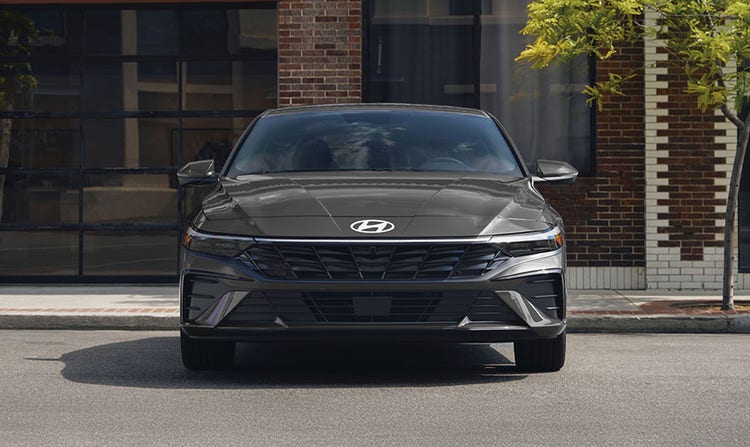
The standard ELANTRA comes with a gasoline engine that can produce up to 147 horsepower. Owners can also opt for a hybrid powertrain that offers up to 139 horsepower, or the ELANTRA N Line Ultimate which features a gasoline engine that can produce 201 horsepower. Those seeking even more power can also consider the ELANTRA N, our high-performance racecar-inspired model with a gasoline powertrain that can produce up to 276 horsepower, with the option to use N Grin Shift (NGS) on the DCT model to reach 286 horsepower for up to 20 seconds. All ELANTRA configurations come with front wheel drive.
Similarly, the SONATA comes standard with a gasoline powertrain that produces 191 horsepower, while the available hybrid powertrain can produce 192 horsepower, and the SONATA N Line can produce an incredible 290 horsepower. The gasoline Preferred-Trend trim comes with All-Wheel Drive.
Gas Mileage
When it comes to gas mileage, both the mid-size ELANTRA and full-size SONATA excel; according to Natural Resources Canada, the ELANTRA offers Best-in-Class fuel efficiency1. The SONATA also provides better-than-average fuel economy compared to other vehicles in its class2.
The base ELANTRA requires about 6.8 L of fuel per 100 km (combined fuel mileage), while the hybrid ELANTRA uses about 4.7 L per 100 km. In comparison, the average mid-size car has a combined gas mileage of 8.9 L/100 km2. This means that the base ELANTRA could save drivers about $663 annually while its hybrid counterpart could save drivers about $1,327 each year, assuming they drive an average of 20,000 km/year and pay $1.58/L for gas.
The base SONATA has a combined fuel consumption of 8.6 L per 100 km; the SONATA Preferred-Trend Hybrid has a combined fuel economy of 5.0 L per 100 km, and the SONATA N Line uses 8.8 L per 100 km (combined). In contrast, the average full-size car in Canada uses 12.6 L of fuel per 100 km (combined) 2. The SONATA’s fuel efficiency could save drivers about $1,264/year for the base model, $2,401/year for the Preferred-Trend Hybrid, or $1,200/year for the N line model if they drive 20,000 km annually and pay $1.58/L for fuel.
Dimensions and Cargo Space
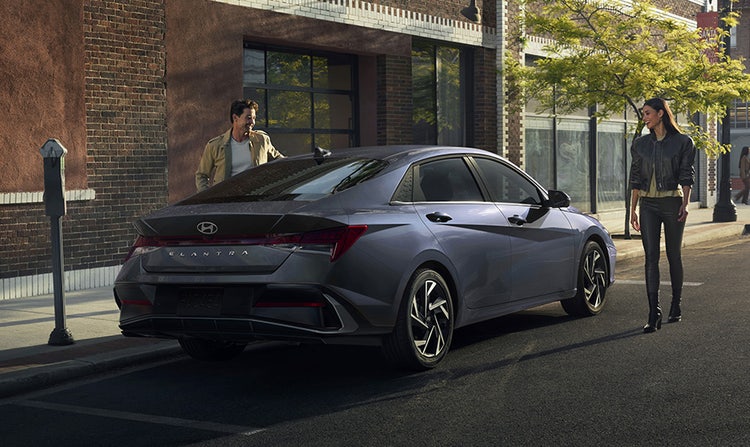
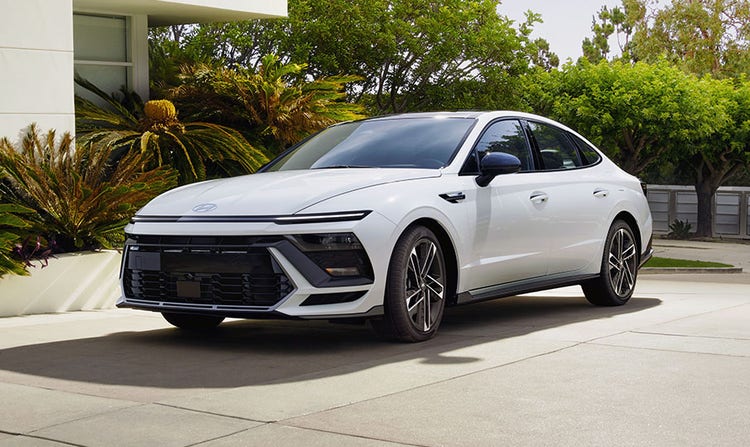
As a full-size car, the SONATA is slightly bigger than the mid-size ELANTRA.
The SONATA measures 4,910 mm long, 1,445 mm tall, and 1,860 mm wide, while the ELANTRA is 4,710 mm long, 1,415-1,420 mm tall (depending on trim), and 1,825 mm wide. The SONATA also comes with a slightly larger trunk: the SONATA offers 441 L of cargo space, while the ELANTRA features a 402 L trunk.
Additionally, the SONATA’s wider body also allows it to offer a slightly larger wheel base: the SONATA’s wheel base measures 2,840 mm, while the ELANTRA’s wheel base is 2,720 mm. Larger wheel bases offer more stability when driving at high speeds, while shorter wheel bases are better for sharper turns. That said, both the SONATA and ELANTRA are well equipped for each scenario–the difference in wheel base size simply offers a slightly different handling experience.
Interior Comfort and Technology
The ELANTRA and SONATA boast comfortable, feature-rich cabins. However, they also both have their own individual benefits.
Interior
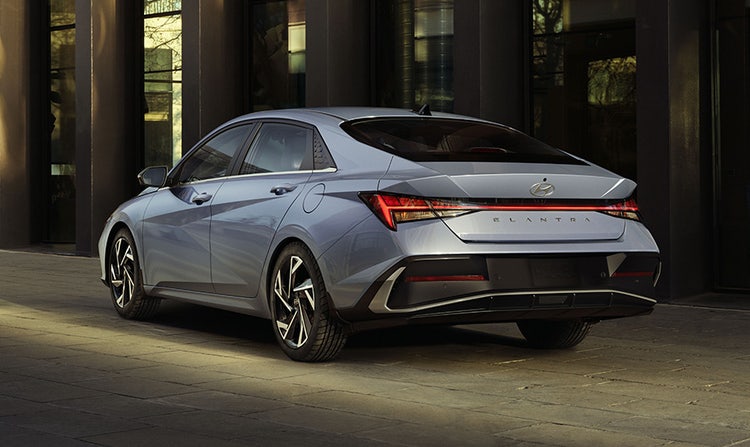
The ELANTRA and SONATA feature stylish interiors that prioritize passenger comfort.
Depending on the trim, ELANTRA and SONATA drivers can enjoy a wide range of comfortable seating surfaces. The ELANTRA comes standard with cloth seats; leather and leatherette are available on select higher-tier trims. Additionally, the ELANTRA N’s seats feature a mix of leatherette and suede. The SONATA comes standard with leather seats, while the SONATA N Line features leather/suede seats.
Both vehicles also boast a wide range of additional features. The SONATA comes standard with a heated, leather-wrapped steering wheel, which is available on the ELANTRA. The SONATA also features a panoramic sunroof, while the ELANTRA has an available power sunroof. Similarly, the SONATA features a standard Dual-zone automatic climate control. The ELANTRA offers an available dual-zone automatic temperature control and defogging system. Additionally, interior ambient lighting is available for both vehicles.
Technology
Both the ELANTRA and SONATA come standard with a wide range of technology-related features and capabilities, including Bluetooth connectivity, Android Auto™ support, Apple CarPlay® support, a keyless entry system, and USB ports. Additionally, an on-board navigation system and a wireless charging pad are available for both vehicles.
Bluelink, Hyundai’s suite of connectivity features, is available on ELANTRA and standard on SONATA. Bluelink adds a wide range of functionality, including the ability to remotely lock or unlock a vehicle, contact emergency services directly from your vehicle, and check vehicle health diagnostics. Each new Hyundai vehicle comes with a complimentary 3-year Bluelink subscription.
Additionally, the ELANTRA comes with a standard 8.0" or an available 10.25" touchscreen infotainment display. The SONATA features a standard 12.3" touchscreen display. Both vehicles offer a 6-speaker audio system, with the option to upgrade to a Bose® audio system.
Safety
The ELANTRA and SONATA come standard with a wide range of active safety features, including:
- Electronic Stability Control system (ESC) w/ Traction Control System (TCS)
- Anti-lock Braking System (ABS) w/ Electronic Brake-force Distribution (EBD)
- Brake Assist (BA)
- Lane Keeping Assist (LKA)
- Lane Following Assist (LFA)
- Driver Attention Warning (DAW)
The SONATA comes standard with Safe Exit Warning (SEW), Forward Collision-Avoidance Assist (FCA) with Pedestrian and Cyclist Detection, and Smart Cruise Control with stop-and-go, all of which are also available on select ELANTRA trims.
Pricing and Overall Value
Both the ELANTRA and SONATA are excellent sedans. However, they each offer their own unique strengths, so depending on your preferences, it may make sense to choose one car over the other.
The ELANTRA has a slightly lower starting price than the SONATA, making it a little more appealing for budget-conscious shoppers. The ELANTRA is also the smaller of the two cars and features a narrower wheel base, resulting in slightly more agile handling. Additionally, while the SONATA and ELANTRA both offer impressive fuel efficiency, the smaller ELANTRA’s better gas mileage allows drivers to enjoy a greater degree of ongoing savings on fuel.
On the other hand, the SONATA comes with a greater variety of standard features, including a heated steering wheel, a panoramic sunroof, and a wider range of automated safety features. The SONATA’s larger size also translates to more trunk space and greater vehicle stability at higher speeds. Additionally, the base and N line SONATA models are more powerful than their ELANTRA counterparts.
You can check out the chart below for a quick refresher on how these two cars compare:
Category
ELANTRA
SONATA
Powertrain Options
- 147 horsepower (gas)
- 139 horsepower (hybrid)
- 201 horsepower (gas, N Line Ultimate)
- 276 horsepower (ELANTRA N)
- 191 horsepower (gas, standard)
- 192 horsepower (Preferred-Trend Hybrid)
- 290 horsepower (gas, N Line)
Gas Mileage (combined)
- Base model: 6.8 L/100 km
- Hybrid model: 4.7 L/100 km
- Best-in-class fuel efficiency1
- Base model: 8.6 L/100 km
- Hybrid model: 5.0 L/100 km
- Better-than-average fuel economy for class2
Dimensions and Cargo Space
- Length: 4,710 mm
- Height: 1,415-1,420 mm
- Width: 1,825 mm
- Wheel base: 2,720 mm
- Trunk: 402 L
- Wheels: 15” standard, available 16”, 17”, 18”; 19” standard on ELANTRA N
- Length: 4,910 mm
- Height: 1,445 mm
- Width: 1,860 mm
- Wheel base: 2,840 mm
- Trunk: 441 L
- Wheels: 18” standard, available 17”, 19”
Interior
- Seating upholstery: Cloth standard, leather and leatherette available
- Rear window defroster
- Available heated, leather-wrapped steering wheel
- Available dual-zone automatic temperature control with defogging
- Available interior ambient lighting
- Seating upholstery: Leather standard, leather/suede seats available
- Heated, leather-wrapped steering wheel
- Automatic temperature control with window defogging
- Available interior ambient lighting
- Standard front heated seats and power driver’s seat
- Available power passenger seat
- Available ventilated front seats
Technology
- 8.0" or available 10.25" touchscreen display
- Bluetooth
- Android Auto™ and Apple CarPlay®
- Keyless entry system
- USB ports
- 6-speaker sound system (8-speaker Bose® system available)
- Available Bluelink compatibility
- Available on-board navigation system
- Available wireless charging pad
- 12.3" touchscreen display
- Bluetooth
- Android Auto™ and Apple CarPlay®
- Keyless entry system
- USB ports
- Standard Bluelink compatibility
- 6-speaker sound system (8-speaker Bose® system available)
- Available on-board navigation system
- Available wireless charging pad
Safety
- Extensive safety suite, with 8 standard and 5 available advanced active safety features
- Extensive standard safety suite, with most advanced active safety features that come standard or are available for the ELANTRA
Ultimately, no matter whether you choose the ELANTRA or SONATA, you’ll be able to enjoy a powerful, fuel-efficient, and safe vehicle.
Ready to Discover Your Next Sedan?
If you’re interested in the ELANTRA or SONATA, you can visit each vehicle’s listing to learn more about its features and capabilities. Or, if you’re ready to explore further, you can use our Build and Price tool to customize your perfect Hyundai sedan. You can also reach out to your
Frequently Asked Questions (FAQ)
If you still have questions about the ELANTRA or SONATA, please consult our list of frequently asked questions below for help. You can also check out the vehicle listings on our website for more information or reach out to your local Hyundai dealership for personalized help.
What are some differences between the ELANTRA and SONATA?
There are a number of differences between the ELANTRA and the SONATA. For example, the SONATA features a variety of standard features that are either unavailable on the ELANTRA or only available on higher-tier models. The SONATA is also bigger than the ELANTRA and features a wider wheel base, leading to more stability while driving. However, the base ELANTRA enjoys better gas mileage than its SONATA counterpart.
Is the SONATA bigger than the ELANTRA?
Yes, the SONATA is bigger than the ELANTRA. The SONATA has a length of 4,910 mm, a height of 1,445 mm, and a width of 1,860 mm, while the ELANTRA has a length of 4,710 mm, a height of 1,415-1,420 mm, and a width of 1,825 mm.
How long can an ELANTRA last?
With proper care, an ELANTRA can last for a long time. In 2020, a 12-year-old ELANTRA in Quebec drove its millionth kilometer and its “original engine was still in excellent running condition with no faults.” The vehicle can handle heavy use, too: in 2018, a 5-year-old ELANTRA drove its millionth mile (approx. 1,600,000 km).
Does the SONATA have a CVT transmission?
No, the SONATA does not have a CVT transmission; the standard SONATA comes with a Smartstream automatic transmission, while the SONATA N Line features a Wet Dual-Clutch Transmission.
Does the SONATA have front wheel drive?
Yes, the SONATA Preferred-Trend Hybrid and N Line come with front wheel drive.
Does the ELANTRA N come with automatic transmission?
The ELANTRA N is available with either a manual or Dual Clutch Transmission (DCT).
1 Best-in-class fuel economy is based on Natural Resources Canada fuel consumption ratings for 2026 hybrid vehicles in the Mid-size class as of January 6, 2026. Based on the Elantra Luxury Hybrid powertrain option.
2 Based on Natural Resources Canada fuel consumption ratings for 2026 conventional and hybrid vehicles in the Full-size class as of November 6, 2025.
Disclaimer: While this article is accurate at the time of publication, it may not reflect the latest updates to vehicles, features, or availability. Please check each model’s respective vehicle listing page on the Hyundai Canada site or contact your local dealership for the most updated information. Descriptions of specific cars and their owners’ experiences are provided anecdotally and should not be taken as a guarantee of lifespan, durability, or a similar experience.