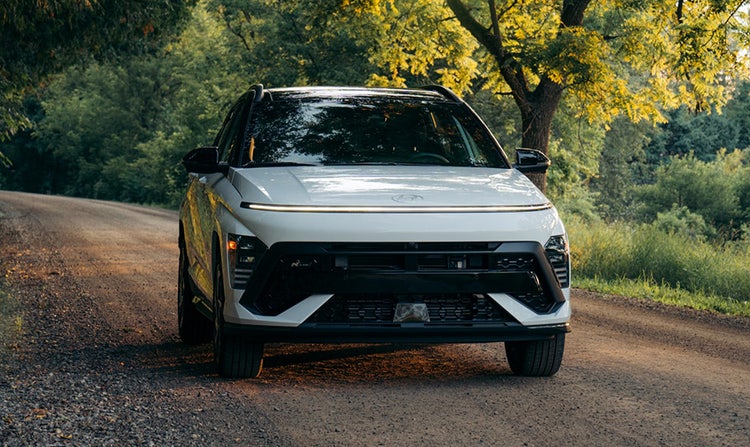
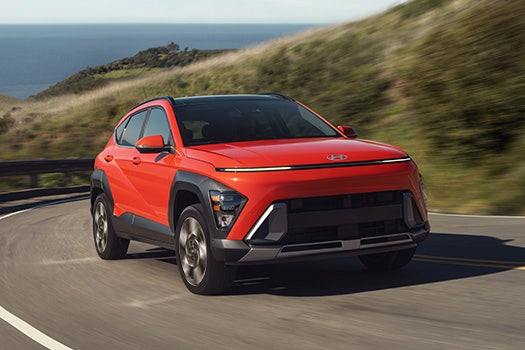
The subcompact SUV market is competitive, with a wide variety of available options. But with so many choices, it can be hard to determine which is the best fit for your lifestyle. To help simplify the search, we’ll take a look at some of the specs and features of four popular models: the Hyundai KONA, Nissan Kicks, Mazda CX-30, and Honda HR-V. That way, you can determine which vehicle best meets your needs.
Dimensions
All four subcompact SUVs offer a relatively small footprint. However, some provide more room for passengers and cargo than others:
- KONA: The standard KONA is 4,350 mm long, 1,825 mm wide, and 1,610 mm high (1,615 mm high for configurations with a 1.6L engine). It provides 723 L of trunk space and 1,803 L of cargo room with the rear seats lowered, as well as 1,059 mm of front-row and 970 mm of rear-row legroom. Despite its compact size, the gasoline KONA provides the most total cargo space (rear seats lowered) and rear-row legroom out of all vehicles on this list.1
- Kicks: The Kicks’ standard configuration has a length of 4,365 mm, a width of 1,800 mm, and a height of 1,630 mm. Additionally, the base model features 849.5 L of trunk space and 1,699.6 L of total cargo space when the rear seats are lowered. Front-row passengers have 1,083.4 mm of legroom, while rear-seat passengers have 876.4 mm of legroom.
- CX-30: The CX-30 has a length of 4,395 mm, a width of 2,040 mm, and a height of 1,568 mm. It offers 1,059 mm of front-row and 922 mm of rear-row legroom, as well as a 572 L trunk and 1,280 L of total cargo space when the rear row is lowered (not including the rear-row floor space). Ultimately, the CX-30’s provides less rear-row legroom and available storage space than the KONA.1
- HR-V: The HR-V measures 4,567.8 mm long, 1,839.9 mm wide, and 1,620.1 mm high, and comes with a 691 L trunk (it offers 1,559 L of total cargo room if the rear seats are lowered). Additionally, it provides 1064 mm of front-row and 958 mm of rear-row legroom.
Powertrains and Fuel Efficiency
When choosing a vehicle, it’s good to look for a balance between power and fuel efficiency. Let’s see how each vehicle compares:
- KONA: Drivers can choose between a variety of different powertrains, including a standard 2.0L gasoline option with 147 horsepower, a gasoline powertrain with a 1.6L turbocharged engine that produces 190 horsepower, or the KONA Electric’s all-electric 201 horsepower configuration. Regardless of whether drivers opt for a fuel or electric model, they will enjoy impressive energy efficiency: the standard gasoline KONA has a combined fuel economy of 7.5L/100 km, while the KONA Electric uses 2.0 Litre equivalents per 100 km.
- Kicks: In Canada, the Kicks is a gasoline car with a 2.0 L engine that can produce 141 horsepower. The front-wheel drive configuration offers a combined fuel economy of 7.4 L per 100 km.
- CX-30: The CX-30 offers multiple gasoline powertrains; the standard 2.5L engine can produce 191 horsepower, while an available 2.5L turbocharged engine produces up to 250 horsepower when using 93 octane fuel. However, the CX-30 is not as fuel-efficient as the KONA or Kicks, with the base model requiring 8.2 L per 100 km (combined).
- HR-V: The HR-V is a gasoline vehicle with a 2.0 L engine that can produce 158 horsepower. With a combined fuel economy of 8.3 L per 100 km, the standard HR-V has the poorest fuel efficiency of the group when equipped with FWD.
Interior
A comfortable, feature-rich cabin can significantly improve the experience of both drivers and passengers. With that in mind, let’s take a closer look at each vehicle’s materials, features, and technology.
Materials and Features
High-quality materials and convenient features can ensure that a cabin feels comfortable. Here’s how each of these four vehicles compare:
- KONA: The standard KONA comes with cloth seats, although leatherette and leather/suede seats are available. The vehicle also features a Day/Night rearview mirror, allowing drivers to cut down on glare. Additionally, the KONA is the only vehicle on this list that offers standard illuminated vanity mirrors. Select configurations come with a heated, leather-wrapped steering wheel; a leather-wrapped shift knob; and an ElectroChromic auto-dimming rearview mirror.
- Kicks: The Kicks comes standard with cloth upholstery, while higher-tier models offer leatherette-appointed seats. Available features include illuminated vanity mirrors, a heated, leather-wrapped steering wheel, a leather-wrapped shift knob, and an auto-dimming rearview mirror.
- CX-30: The CX-30 features standard cloth upholstery, with leather- and leatherette-trimmed seats available on select configurations. Similarly to the KONA, a Day/Night rearview mirror is standard, while a heated, leather-wrapped steering wheel; a leather-wrapped shift knob; an auto-dimming rearview mirror; and an illuminated vanity mirror are available.
- HR-V: The standard HR-V offers cloth seats, while select configurations come with leather-trimmed seats. Available features include a heated, leather-wrapped steering wheel; a leather-wrapped shift knob; and illuminated vanity mirrors.
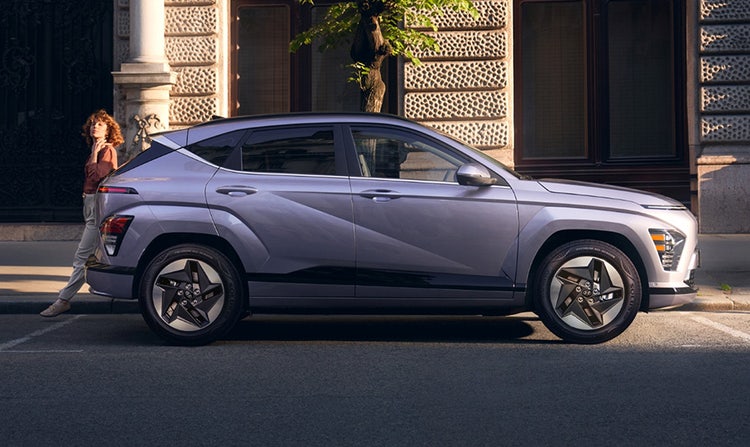
Technology
Many vehicles are filled with a wide range of convenient digital features, including the ability to connect to your phone’s navigation system, remotely control the cabin temperature, and more. Let’s see how these subcompact SUVs stack up:
- KONA: The KONA’s 12.3" touchscreen infotainment display offers seamless connectivity with standard wireless Apple CarPlay® and Android Auto™, as well as 3 years of complimentary access to Bluelink ®, Hyundai’s connectivity suite. Bluelink allows drivers to remotely lock their vehicle, set its temperature, and more. The KONA also offers fob-based remote start and keyless entry. Additionally, it provides plenty of power for all passengers with 4 USB-C ports (2 in the front, 2 in the rear) and an available wireless charging pad.
- Kicks: Like the KONA, the Kicks’ infotainment system features a 12.3" display with standard wireless support for Apple CarPlay and Android Auto, as well as the subscription-based NissanConnect package. The Kicks also features a keyless entry system, 2 standard USB-C ports, and an available wireless charging pad.
- CX-30: The CX-30 comes standard with an 8.8" infotainment display, while higher-tier trims offer a 10.25" screen. The infotainment system features wired support for Apple CarPlay and Android Auto, as well as a 2-year trial for Mazda Connected Services. The CX-30 also comes with a keyless entry system and 2 charging ports. USB-C ports are available on higher-tier trims – the standard CX-30 comes with 2 USB-A ports.
- HR-V: The HR-V offers the smallest standard infotainment screen of the four SUVs: a 7" display comes standard, while a 9" screen is available. All HR-V configurations feature USB-A and USB-C ports, support proximity key entry, and support wired Apple CarPlay and Android Auto. However, Hondalink infotainment access is restricted to the highest-tier trim, as is the available wireless charger and wireless Apple CarPlay and Android Auto; notably, the HR-V is the only vehicle on this list whose base configuration cannot access a connectivity suite.
Safety
When choosing a vehicle, safety is of the utmost importance. After all, safe vehicle designs and Advanced Driver-Assistance Systems (ADAS) can offer significant protection in unexpected situations. Let’s see how each vehicle compares:
- KONA: The Insurance Institute for Highway Safety (IIHS) recognized the KONA’s incredibly safe design with a prestigious Top Safety Pick+ designation in 2025. Furthermore, the KONA comes with a wide range of ADAS, including Blind-Spot Collision Warning, Forward Collision-Avoidance Assist with Pedestrian and Cyclist Detection, Rear Cross-Traffic Collision Avoidance Assist, Lane Following Assist, and Lane Keeping Assist. Available ADAS include Adaptive Cruise Control with support for stop-and-go traffic, Highway Driving Assist, and Surround View Monitor. Additionally, an anti-lock braking system helps drivers to maintain control of the vehicle.
- Kicks: Although the Kicks comes with a variety of ADAS (including Predictive Forward Collision Warning and Rear Cross Traffic Alert), it was the only vehicle on this list to not receive a Top Safety Pick+ or Top Safety Pick designation from the IIHS in 2025. In fact, the 2025 Kicks received poor results in an IIHS crash test due to insufficient rear passenger dummy protection.
- CX-30: Like the KONA, the CX-30 received a Top Safety Pick+ designation from the IIHS for 2025. The vehicle comes with a wide variety of ADAS, including Rear Cross Traffic Alert, Pedestrian Detection, and Distance and Speed Alert.
- HR-V: The HR-V was also awarded a 2025 Top Safety Pick+ designation by the IIHS. Additionally, it features many ADAS, including Forward Collision Warning, Collision Mitigation Braking System, and Lane Departure Warning.
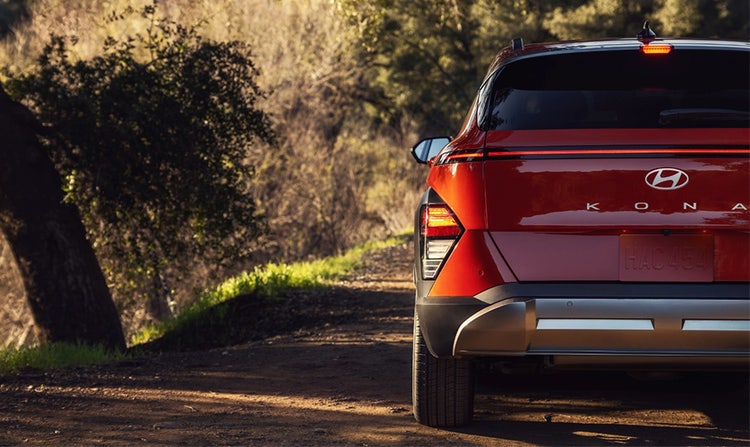
KONA: A Great Subcompact SUV
The KONA offers a wide range of powerful, energy-efficient powertrains, allowing drivers to choose the configuration that works best for them. Despite its compact footprint, it provides ample legroom and the most cargo space out of all four SUVs1. Additionally, it offers a feature-rich cabin and 3 years of complimentary access to Bluelink. Plus, the KONA’s ADAS suite and award-winning safe design can offer significant protection in dangerous situations.
Curious about the KONA? To customize your own vehicle–including its powertrain, interior, and more–please visit the Build and Price tool. Alternatively, you can book a test drive at your local dealership to explore the KONA firsthand.
Frequently Asked Questions (FAQ)
If you still have questions about the KONA, please consult the FAQ below. Alternatively, you can reach out to your local Hyundai dealership for personalized assistance.
Does Hyundai KONA come in AWD?
The gasoline KONA comes standard with FWD, but AWD is available. Additionally, some trims are AWD-only.
What gas does a Hyundai KONA take?
Hyundai Canada recommends regular unleaded fuel for the KONA.
Does the Hyundai KONA Electric have a heat pump?
Yes, the KONA Electric comes with a heat pump system which captures and reuses the energy from ambient heat, ultimately extending the vehicle’s battery life.
1KONA dimension metrics only apply to KONA models, not KONA Electric models.
Disclaimer: This article only discusses models and configurations available in Canada. While this article is believed to be accurate at the time of publication, it may not reflect the latest updates to vehicles, features, or availability. For the most accurate and up-to-date information, please contact each model’s respective manufacturer. For information about Hyundai Canada’s vehicles, please consult each model’s respective vehicle listing page on the Hyundai Canada website. Hyundai Canada is not responsible for actions taken based on this content.