
At Hyundai, we continually strive to improve our vehicles so they can better meet drivers’ everyday needs. That’s why we’ve gone to great lengths to offer impressive fuel or energy efficiency across all our models.
Wondering which of our vehicles are the most efficient? Below, we’ll explore our gasoline, hybrid, and electric lineups, highlighting the most efficient sedan and SUV in each category.
Most Fuel-Efficient Canadian Hyundai Hybrid Cars
Like our gasoline cars, our hybrid vehicles offer incredible fuel efficiency. In fact, all hybrid configurations of the models below offer better-than-average fuel efficiency compared to other gasoline and hybrid vehicles in their class.
Hybrid Sedan: Hyundai ELANTRA
At just 4.7 L/100 km, the ELANTRA Luxury Hybrid offers an incredibly low combined fuel efficiency (4.8 L/100 km for city driving, 4.5 L/100 km for highway driving). In fact, it features best-in-class fuel economy2.
The average mid-size sedan in Canada has a combined fuel economy of 8.7 L/100 km1. This means that ELANTRA Luxury Hybrid drivers can save about $1,200 annually, if they drive about 20,000 km/year and pay $1.50/L.
Hybrid SUV: Hyundai TUCSON
The hybrid TUCSON is our most fuel-efficient hybrid SUV, featuring a city, highway, and combined fuel economy of 6.7 L/100 km.
With such competitive gas mileage, the hybrid TUCSON offers substantial fuel savings compared to other vehicles in its class. Since the average small SUV in Canada has a fuel efficiency of 9.3 L/100km1, a hybrid TUCSON owner can expect to save around $780 in fuel costs annually (assuming that they drive about 20,000 km/year and pay $1.50/L for fuel).
Honourable Mention: Hyundai PALISADE
If you’re looking for a hybrid mid-size SUV, the 3-row PALISADE is an excellent choice. The PALISADE comes in hybrid, and can seat up to 7 or 8 passengers depending on configuration. All hybrid PALISADE models have an estimated combined fuel economy of 8.1 Le/100 km.
In comparison, the average vehicle in the PALISADE’s class has an estimated combined fuel economy of 12.5 L/100 km. This means that a PALISADE driver can expect to save about $1,320/year on fuel, assuming they drive 20,000 km annually and pay $1.50/L for gasoline.
Most Fuel-Efficient Canadian Hyundai Hybrid Cars
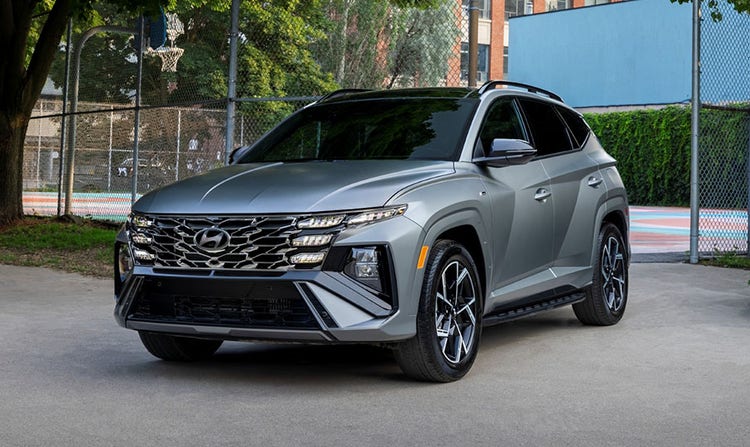
The vehicles highlighted below don’t just offer greater fuel efficiency than the rest of Hyundai’s gasoline cars – they’re more efficient than many competitors, too. All configurations of the models below (other than the racecar-inspired ELANTRA N Line Ultimate) offer better-than-average fuel efficiency compared to other gasoline or hybrid vehicles in their respective class.
Gasoline Sedan: Hyundai ELANTRA
The ELANTRA offers the best fuel economy out of any gasoline Hyundai sedan.
While different configurations provide slightly different gas mileage, the ELANTRA Essential offers a combined fuel economy of 6.8 L/100 km, with 7.5 L/100 km for city driving and 5.9 L/100 km for highway driving.
In contrast, the average mid-size sedan in Canada has a combined fuel economy of 8.7 L/100 km1. This means that an ELANTRA Essential owner could expect to save about $570 annually if they drive 20,000 km/year and pay $1.50/L for fuel.
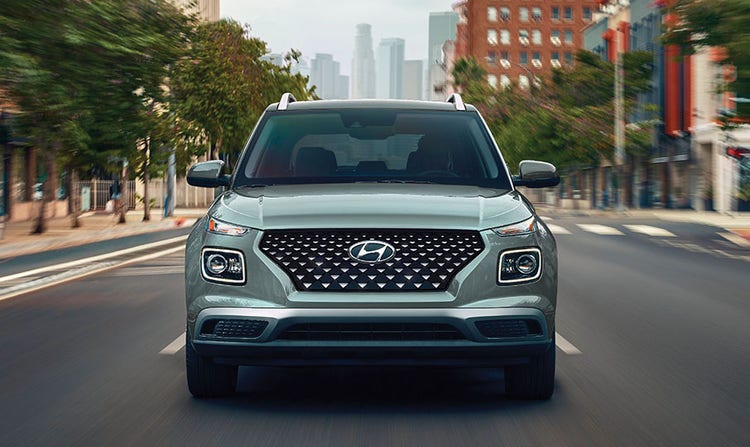
Gasoline SUVs: Hyundai KONA and Hyundai VENUE
The KONA Essential and VENUE are tied for the position of the most fuel-efficient gasoline Hyundai SUV, each providing a combined fuel economy of 7.5 L/100 km.
For comparison, the average small SUV in Canada has a combined fuel efficiency of 9.3 L/100 km1. By opting for a KONA Essential or a VENUE, drivers could save about $540 annually, if they pay $1.50/L and drive 20,000 km/year.
Notably though, each vehicle offers slightly different mileage depending on the situation. The KONA Essential has a small edge for highway driving, offering a fuel efficiency of 6.8 L/100 km on the highway and 8.1 L/100 km in the city when using Front-Wheel Drive (FWD). On the other hand, the VENUE is slightly better for city driving, requiring just 7.9 L/100 km in the city and 6.9 L/100 km on the highway.
Most Energy-Efficient Canadian Hyundai Electric Vehicles
Looking for an electric vehicle? Like our gasoline and hybrid cars, our most efficient EVs offer great performance compared to their competitors.
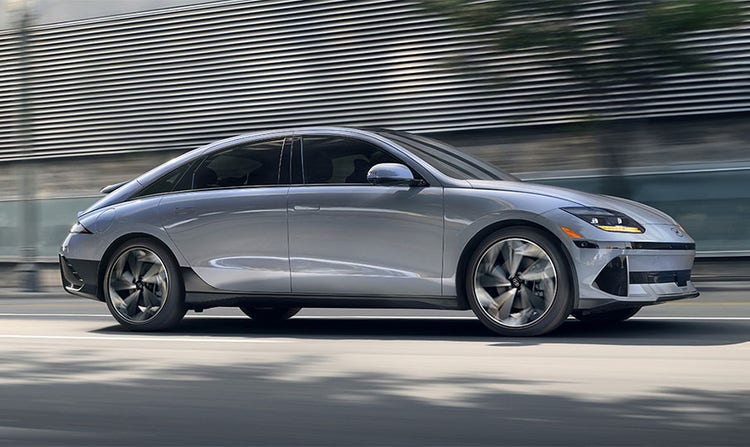
Electric Sedan: Hyundai IONIQ 6
As our only all-electric sedan, the IONIQ 6 is unsurprisingly our most energy-efficient electric sedan. Energy efficiency varies by trim, but all IONIQ 6 configurations offer better-than-average energy efficiency compared to other mid-size electric sedans1.
The IONIQ 6 Preferred Long Range offers a particularly low combined energy efficiency of 1.8 Litre equivalents (Le)/100 km (1.6 Le/100 km for city driving, 2 Le/100 km for highway driving). In contrast, the average mid-size electric sedan has a combined energy efficiency of 2.4 Le/100 km1. This means that an IONIQ 6 Preferred Long Range owner can expect to save about $149.52 annually if they drive 20,000 km each year and pay $0.14 per kWh to recharge their vehicle.
Electric SUV: Hyundai IONIQ 5
The IONIQ 5 is our most fuel-efficient electric SUV, with the Preferred Long Range configuration offering a remarkable combined energy efficiency of 1.9 Le/100 km1. The IONIQ 5 Preferred Long Range requires just 1.7 Le/100 km for city driving and 2.1 Le/100 km for highway driving.
In contrast, the average small electric SUV in Canada requires 2.3 Le/100 km (combined)1. This means that an IONIQ 5 Preferred Long Range owner could expect to save about $99.68 each year, assuming that they pay $0.14 per kWh and drive 20,000 annually.
Customize Your Hyundai Today
Interested in personalizing your own fuel- or energy-efficient Hyundai? Simply visit our Build & Price tool to explore your options. Alternatively, if you’d prefer to arrange a test drive, you can contact your local Hyundai dealership.
Frequently Asked Questions (FAQ)
If you still have questions about our vehicles’ fuel-related specifications, please check out our list of frequently asked questions below. You can also reach out to your local Hyundai dealership for assistance.
What is the gas mileage of a Hyundai ELANTRA?
The ELANTRA Essential offers a combined gas mileage of 6.8 L/100 km, with a fuel economy of 7.5 L/100 km for city driving and 5.9 L/100 km for highway driving.
The ELANTRA Luxury Hybrid provides a combined gas mileage of 4.7 L/100 km, with 4.8 L/100 km for city driving and 4.5 L/100 km for highway driving.
Other trims and configurations may have different gas mileage ratings.
How big is the gas tank on a Hyundai ELANTRA?
All gasoline ELANTRA models come with a 47 L gas tank; the hybrid ELANTRA model features a 42 L gas tank.
What is the gas mileage of a Hyundai TUCSON?
The gasoline TUCSON configurations have an overall combined fuel economy of 8.8 L/100 km, with 9.7 L/100 km for city driving and 7.7 L/100 km for highway driving.
The hybrid TUCSON configurations have a city, highway, and overall combined fuel economy of 6.7 L/100 km.
The plug-in hybrid TUCSON configuration offers an impressive combined fuel economy of 3.1 Le/100 km when operating solely with electric power.
How much gas does a Hyundai TUCSON hold?
Gasoline TUCSON models have a 54 L fuel tank, while hybrid TUCSON models have a 52 L fuel tank. The plug-in hybrid electric TUCSON has a 42 L fuel tank.
What is the gas mileage of a Hyundai KONA?
The standard Kona Essential has a 7.5 L/100 km combined fuel economy rating when driving using FWD, with 8.1 L/100 km for city driving and 6.8 L/100 km for highway driving.
Other trims and configurations may have different gas mileage ratings.
How big is the Hyundai KONA’s gas tank?
The KONA offers a 47-50 L gas tank, depending on powertrain configuration.
What is the gas mileage of a Hyundai VENUE?
The VENUE features a combined fuel economy of 7.5 L/100 km, with 7.9 L/100 km for city driving and 6.9 L/100 km for highway driving.
How big is the Hyundai VENUE’s gas tank?
The VENUE has a 45 L gas tank.
1 Fuel- and energy-efficiency averages and comparisons are based on the Government of Canada’s Fuel consumption ratings data sets as of January 19, 2026. Electric sedan comparisons only include 2025 model year vehicles. All other comparisons only include 2026 model year vehicles.
2 Best-in-class fuel economy is based on Natural Resources Canada fuel consumption ratings for 2026 hybrid vehicles in the Mid-size class as of January 19, 2026. Based on the Elantra Luxury Hybrid powertrain option.
DISCLAIMER
The information in this blog is for general reference only and may not reflect current vehicle specifications, features, pricing, or availability. Details may change over time due to updates or model revisions.
For the latest and most reliable information about a particular vehicle, please visit the manufacturer’s official website. Hyundai Canada is not responsible for errors, omissions, or actions taken based on this content.

