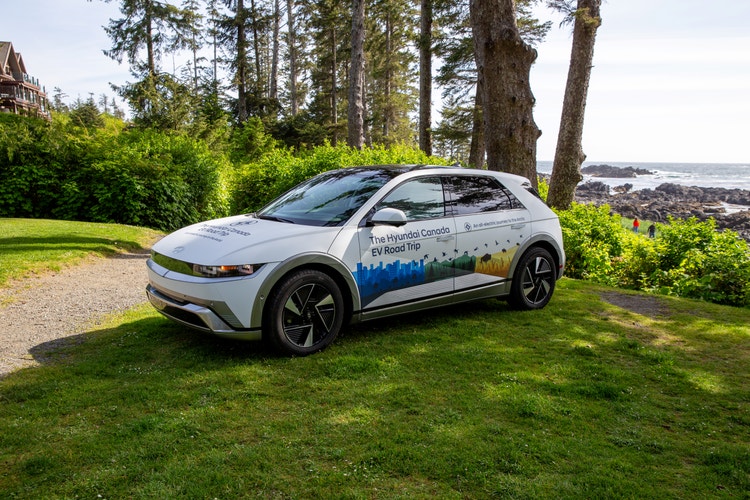
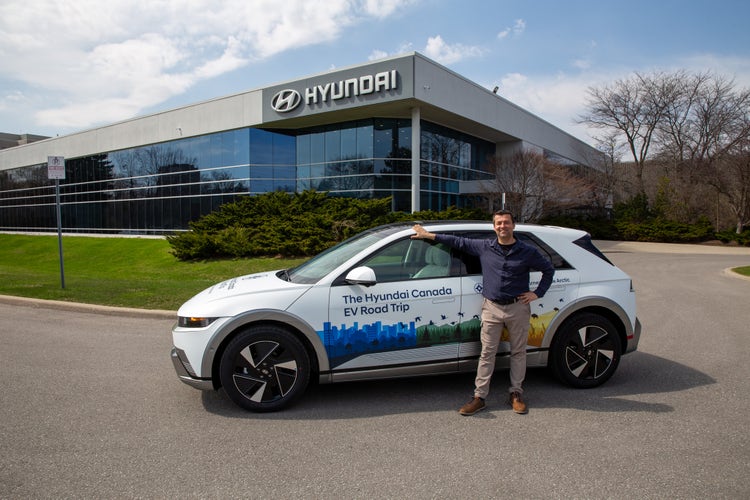
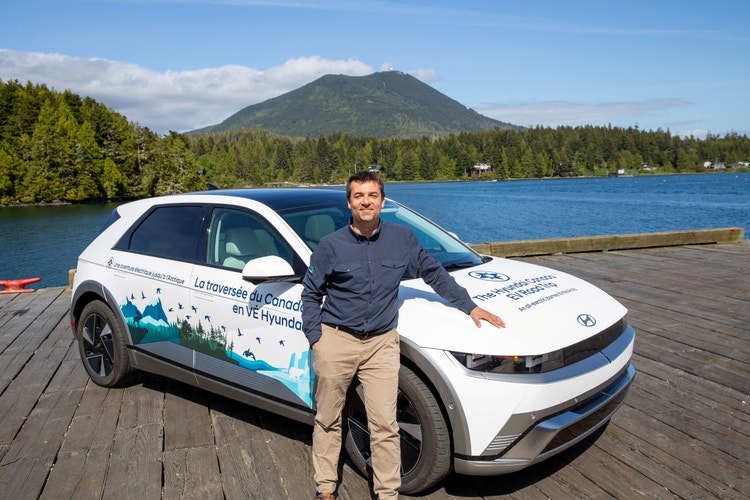
Electric vehicles have a great reputation, but many people still doubt how they hold up under intense demands. Never one to shy away from a challenge, electric vehicle enthusiast Patrick Nadeau put an all-electric 2025 IONIQ 5 to the test with a 19,743 km road trip from Hyundai Canada’s headquarters in Markham, Ontario to Tuktoyaktuk, Northwest Territories – north of the Arctic Circle – and back again.
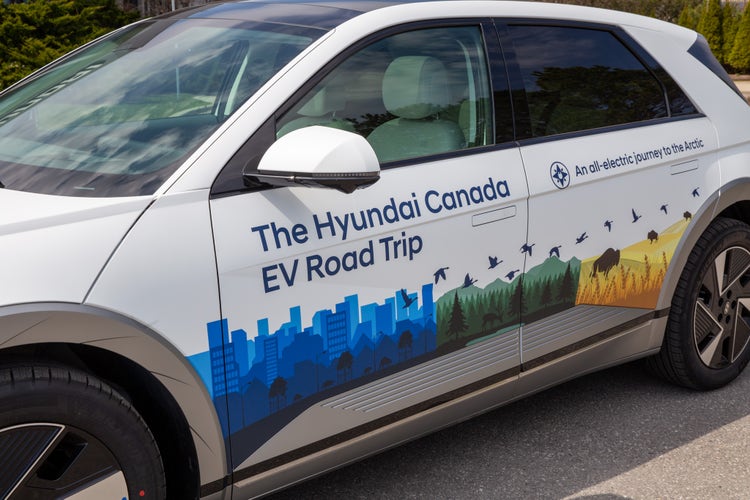
Patrick’s journey was long, and it was not easy. Freezing temperatures delayed ferry schedules for days. The trip included some dangerous driving conditions, including Patrick’s trip along the Dempster Highway – a mostly-unpaved 700 km highway from Dawson City, Yukon to Inuvik, Northwest Territories. Still, he was able to successfully complete his road trip in a 2025 Hyundai IONIQ 5 Preferred with the Ultimate package, whose only modification was a custom exterior wrap. In doing so, Patrick challenged many myths about electric vehicles and how well they can handle extreme road trips.
Myth #1: EV Ranges Cause Problems for Road Trips
Many people think that EV ranges cause big problems for road trips. Some early EVs had limited ranges, but modern EVs can typically travel for extended periods before recharging. The 2025 IONIQ 5 Preferred Long-Range AWD with Ultimate package (19”) that Patrick drove on this trip has a range of up to 463 km1, making it an excellent road trip companion. Additionally, the standard 2026 IONIQ 5 Preferred Long Range has a range of 504 km1.
The other IONIQ cars have impressive range, too: the 2026 IONIQ 9, a 3-row SUV, comes standard with a 539 km range1 that provides even more flexibility. Meanwhile, the standard 2025 IONIQ 6, a mid-size sedan, has a 550 km range1 – perfect for those seeking a more compact option.
Myth #2: Charging Stops Cause Unwanted Delays
Some people believe that road trip charging stops cause long, unwanted delays. But not all EVs take long to charge: the entire IONIQ lineup supports rapid charging; the IONIQ 5 takes just 18 minutes to recharge from 10% to 80% using a 350 kW rapid charger2. That’s plenty of time to stretch your legs or grab a quick bite, allowing you to recharge while your car does. In fact, Patrick went for a walk while charging his car in Vancouver Island, allowing him to take in the beautiful scenery before continuing on his journey.
Myth #3: Remote Areas Lack Charging Stations
It’s easy to assume that charging stations are only available in cities, making some road trips impossible with an EV. Fortunately, the truth is very different.
Patrick’s travels took him across Canada, visiting both bustling cities and remote communities. He found charging stations all around the country and was even surprised to see many free charging stations up north.
Of course, when going on an EV road trip, it’s important to plan ahead. An EV charging map like PlugShare allows you to check for chargers along your route; many maps even allow you to filter for free charging. Still, chances are that you’ll be able to find a wide variety of charging stations no matter where you’re headed.
Myth #4: All EVs Struggle in Colder Temperatures
It’s true that all batteries, including car batteries, experience a drop in efficiency in cold temperatures. But some EVs, including Hyundai’s, come with technology that assists with minimizing the impact.
All current Hyundai EVs come with a heat pump which absorbs ambient heat from the outside air and warms the battery while charging or driving. This helps to preserve the battery’s original capabilities in the cold. Heat pumps also direct excess heat to the cabin so the car doesn't have to use as much of the battery’s power to keep passengers warm.
For Patrick, the heat pump was key to crossing the famously difficult Dempster Highway, a feat that wouldn’t have been possible without Hyundai’s range-preserving technology.
Myth #5: EVs Can’t Handle Adventures
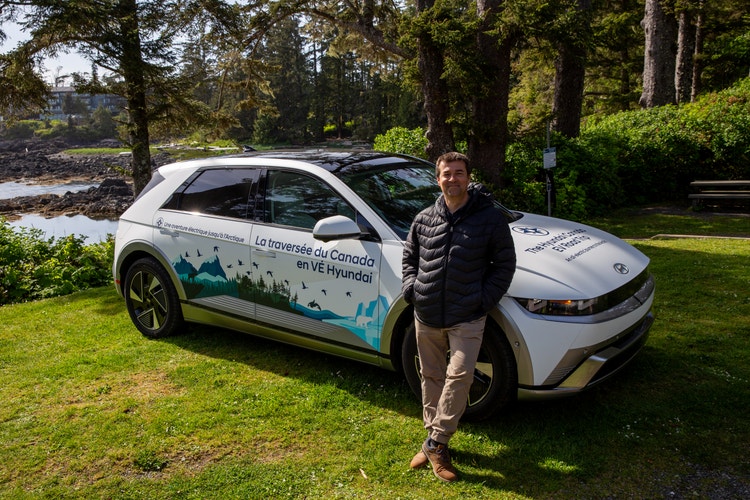
EVs are often associated with city driving, so it’s easy to assume that they can’t keep up with adventures. In reality, nothing could be farther from the truth. Patrick often found himself camping, and no matter the situation, the IONIQ 5 was always a trustworthy companion.
While staying at the Hope Mountain Centre for Outdoor Learning in British Columbia, the IONIQ 5’s spacious interior became a comfortable source of shelter. Patrick also took advantage of the car’s Vehicle-to-Load charging capabilities to power an electric kettle, making the journey a bit more luxurious.
After driving north, Patrick planned on crossing a river by ferry, but the Peel and Mackenzie Rivers were frozen, so boats could not sail. Worse, local hotels were fully booked and it was raining, making outdoor camping unappealing. Fortunately, Patrick could sleep in the IONIQ 5 again3. And since the car only used about 10% of its battery to warm the cabin for roughly 12 hours, Patrick didn’t need to worry about finding a charging station when it was time to leave.
Myth #6: EVs Struggle with Difficult Terrain
Since EVs are so closely associated with city driving, it can be difficult to picture them performing well in difficult terrain, including unpaved roads and steep mountains. But Patrick’s road trip proved that the IONIQ 5 can handle all sorts of terrain4, including the Dempster Highway’s nearly 700 km of gravel road.
The IONIQ lineup’s regenerative braking system made the IONIQ 5 ideal for steep roads, too. While all cars – gasoline and electric – use extra power to drive uphill, regenerative braking allows the IONIQ EVs to recharge as they brake while descending. In other words, when travelling through the Rocky Mountains, Patrick was able to drive for longer distances without needing to recharge.
Discover Your Next Electric Vehicle
Patrick’s Arctic road trip was proof that EVs have fewer limits than people might assume – and that they’re great companions for daily driving and outdoor adventures alike.
Interested in an electric vehicle? Our IONIQ lineup includes a variety of impressive cars, including the IONIQ 5, a compact crossover SUV; the IONIQ 5 N, a racetrack-ready compact crossover SUV; the IONIQ 9, a 3-row SUV; and the IONIQ 6, a mid-size sedan. Additionally, the KONA Electric, a subcompact crossover SUV, is a more compact alternative for those seeking an electric SUV.
You can use our Build and Price tool to customize your ideal Hyundai EV. Or, schedule a test drive at your local Hyundai dealership to experience these EVs firsthand.
Frequently Asked Questions (FAQ)